Alessandro Zamboni presents
The Prepper & Homesteading Book Builder
Books readers need every year, not just this month.
Discover the BuilderCreate Prepper & Survival Books With 72 Ready-To-Write Topics That You Can Turn In 23.5 Million Possible Combinations.
Pick a topic, describe your reader, and paste one prompt into Claude. That's how I got a complete 25,000-word guide in my own test. Trend books fade when the trend does. These topics are about decisions people make every year.
Dimesale: the price rose $0.10 every 10 sales and has now reached its $17 ceiling. And yes, you can sell every book you create.
Dear fellow publisher
You know the pattern.
You spot a niche that's selling. You publish into it. For a while, the royalties come in.
Then the niche cools off. More publishers arrive. The book that paid you last month barely moves, and you're back to searching for the next opening.
It's not a writing problem. And it's not a speed problem either.
The problem is publishing books that readers only need for a while.
I've been selling digital products since 2008, and these days one question decides which projects I start:
Will people still need this next year?
Or put another way: what can a reader need in March, in July, and in October, this year and the next?
Why this niche is growing
This Year, The World Got Less Predictable.

You already know pantry and garden books sell all year. This year added a harder reason.
- Nov 3, 2026 · ParaguayThe Central Bank seized Ueno Bank and froze its deposits. Around 3 million customers, roughly 60% of the country's adults, opened the app to a screen that said "We cannot display your balance." A week later, many still could not reach their money.
- Nov 6, 2026 · JapanA system failure stopped ATMs, branch counters and online banking at 128 regional banks and about 3,430 branches at once, with no warning the night before. People could not withdraw cash.
- Oct–Nov 2026 · EuropeMore than 1,700 cost-of-living demonstrations in 31 European countries since mid-September, with riots and looting in German, French and Portuguese cities.
- Nov 2026 · European flightsDozens of hoax bomb threats sent passenger planes to military bases, with fighter jets scrambled to escort flights into Rome, Sofia and Budapest.
None of this happened to people who ignore the news. It happened to people with a bank account, a job and a normal week.
That is the reader who starts looking for a pantry plan, a water plan, a garden plan. And they want a book that tells them what to do, in order.
The situation has never been this tense. That is not good news. But it is why this genre keeps growing.
The audience, by the numbers
This Is Not A Small Club Anymore.
Prepping is no longer a fringe subculture. It's a household category, and the people entering it are younger than the ones who were here ten years ago.
And it isn't only North America. Interest in preparedness manuals has grown sharply in the UK, Europe, Japan and South Korea, driven by climate worries, geopolitical tension and falling trust in institutions.
Here's the part that matters if you publish books.
These readers want knowledge they can hold. A guide they can read when the power is out, the internet is down and the phone battery is dead. That is the reason a prepper buys a book at all: it works when nothing else does.
Millions of readers, one genre, and a format they specifically ask for.
Market and survey estimates, compiled November 2026.
Why this genre
Pantries Get Stocked Every Month. Gardens Get Planned Every Season. The Power Doesn't Book An Appointment Before It Goes Out.
That's what I love about prepper and homesteading topics.
People plan a working pantry before winter. They plan a small-space garden in late winter. They read up on water storage after a dry summer, and on home energy after a blackout on the news.
These aren't trends. They're household decisions people keep making, year after year. And the readers who make them want practical, usable books: something they can keep next to the pantry shelf or the garden planner and actually work from.
That's the kind of book that doesn't care what's trending this month.
There was just one problem.
The problem
Ask Your AI To "Write A Prepping Book," And You Get A Prepping Book Nobody Wants To Read.
If you've tried it, you know what happens. One-line prompt in, and you get:
- Chapter 3 repeating Chapter 1 in different words.
- "It's important to be prepared" on every other page.
- Generic advice that ignores who the reader is, where they live, and how much space they have.
- No worksheets, no checklists, nothing a reader can actually use.
It's not your fault, and it's not the AI's fault. A one-line prompt makes the AI decide everything on its own: who the reader is, what each chapter is for, what goes in and what stays out. So it fills space.
A good editor would never let a writer start like that. They'd hand over a brief first.
So that's what I built.
Introducing
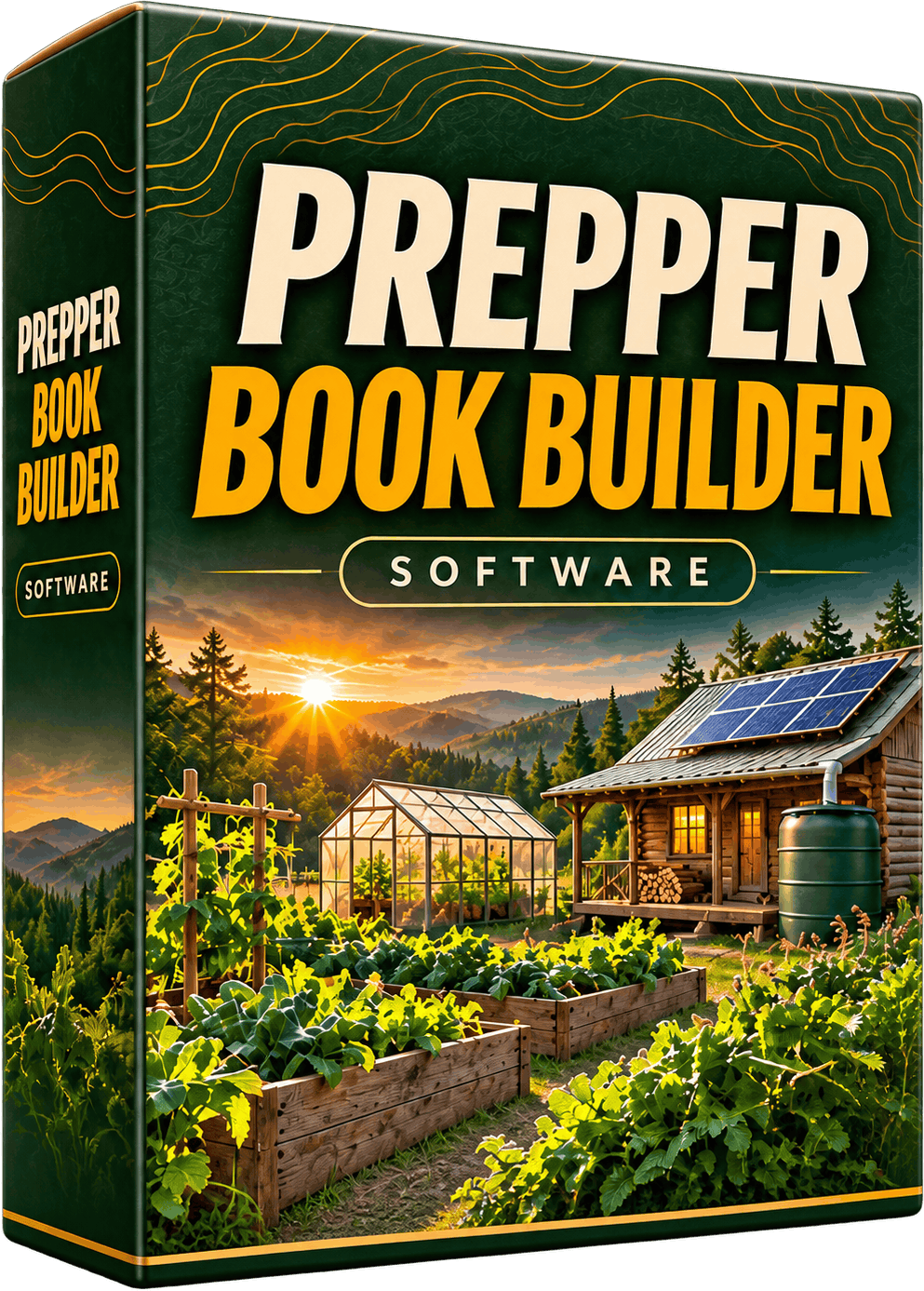
The Prepper & Homesteading Book Builder
A browser tool that turns your topic choices into a complete editorial brief for your AI, built on one rule:
Every chapter gets one job.
That's the One-Job Chapter Brief. Before the AI writes a single paragraph, every chapter is assigned a distinct practical outcome: a decision the reader makes, a record they fill in, or a system they understand. Then the AI writes the book chapter by chapter, following that plan.
- No padding, because every chapter has a reason to exist.
- No repetition, because every chapter has a different job.
- No generic advice, because the brief tells the AI exactly who it's writing for.
My own test
Here's What Happened When I Tested It Myself.
I picked one topic, described the reader, chose a format, and copied the prompt the builder generated into my AI.
About an hour later, I had a complete 25,000-word guide.
I used Claude, the only AI I use for writing.
Not an outline. Not a pile of notes. A structured book with a table of contents, chapters that each do something different, worked examples, and worksheets a reader can fill in.
That's when I knew I had to open it up to other publishers.
These are the monthly sales of some survival and prepper books that don't sit in general niches:
| Est. Mo. Sales | Est. Mo. Rev. | Reviews |
|---|---|---|
| 30,646 | $1,072,610 | 1 |
| 5,766 | $513,174 | 5,048 |
| 7,867 | $291,079 | 6,787 |
| 10,621 | $227,608 | 8,394 |
| 5,493 | $197,254 | 1,481 |
| 4,814 | $153,904 | 267 |
| 7,406 | $99,907 | 5,501 |
| 1,577 | $85,221 | 4,709 |
| 2,956 | $84,157 | 4,099 |
| 4,019 | $60,245 | 1,468 |
| 4,737 | $44,196 | 3,396 |
| 2,612 | $40,564 | 25,788 |
Estimated monthly figures from a market research tool, pulled in November 2026. The top row has a single review.
These Books Have Got Great Ideas Behind, And They Are Selling Every Month.
How it works
Four Steps, Then Your AI Writes

Step 1: Pick your topic
Choose from 72 topics in nine families, or start with one of six ready-made bundles.
Step 2: Describe your reader
Skill level, household, renter or owner, available space, climate, country and region, language and units. Add a budget or limits, a title idea, or anything else you want included. A pantry book for two adults in a small apartment comes out completely different from one for a large rural family, because it should.
Step 3: Choose the format and length
A practical handbook, a step-by-step course in book form, a seasonal planner, or a desk reference. Compact (12,000–18,000 words), Standard (25,000–40,000), or Reference (45,000–65,000).
Step 4: Copy the prompt into your AI and follow the workflow
The AI proposes the plan, you approve or adjust it, and then it writes the manuscript chapter by chapter using the commands built into your prompt.
What your AI builds for you
Every brief tells the AI to deliver:
- Three title and subtitle options, so you're not stuck staring at a blank title field in KDP.
- A reader promise and a full table of contents, planned before any chapter is written. This is why the book doesn't wander.
- Chapters with distinct practical outcomes: the One-Job rule, applied to every single chapter.
- Worked examples with clearly labeled assumptions, so readers see the advice in a real situation.
- Worksheets, logs and checklists suited to the topic. This is the "keep it next to the pantry" part readers come back to.
- Appendices and a glossary that make a short guide feel like a complete reference.
- A source ledger and consolidated references, so you can see where the information comes from.
- Progress tracking for longer books, so the AI keeps its place across installments.
- A final editorial handoff that lists anything left to check before you publish.
72 topics · nine families
One Genre That Works All Year.
| Topic family | What you can cover |
|---|---|
| Homestead design and getting started | Small lots, renter-friendly systems, accessible layouts, phased upgrades |
| Pantry and long-term food storage | Inventory, rotation, dry staples, freezer records |
| Food preservation and the harvest kitchen | Seasonal planning, matching crops to equipment, tested-method research |
| Gardening and seed independence | Containers, succession planting, seed records, irrigation |
| Water and sanitation | Water budgets, storage, well service planning, maintenance records |
| Off-grid power and home energy | Load estimates, solar feasibility, battery comparisons, upkeep |
| Small livestock | Housing, feed budgets, routine chores, welfare planning |
| Repair, resource loops and workshops | Tool care, mending, composting, spare parts |
| Household operations and seasonal routines | Chore calendars, supplier coordination, progress tracking |
Or start with one of six ready-made bundles:
- The Year-Round Working Pantry
- The Harvest-to-Pantry Handbook
- Small-Space Homestead
- Off-Grid Power Planning for Beginners
- The Water-Wise Homestead
- The First-Year Backyard Homestead
Count every fixed setting (skill level, household, renter or owner, space, climate, book size, style, units, and how the AI starts) and one topic alone has 326,592 ways to tailor the book to your reader.
Across all 72 topics, that's about 23.5 million possible setups, before you combine topics or add your own words in the free-text fields.
Is this for you?
It's for you if:
- You publish on KDP, whether you have one title or hundreds, and want a new genre that isn't tied to one season.
- You already use an AI like ChatGPT, Claude or Gemini, and you're tired of getting thin, repetitive manuscripts out of it.
- You want practical nonfiction that readers keep and use.
It's not for you if:
- You want wilderness survival, tactical, weapons or medical-treatment books. Those are deliberately outside the builder's scope.
- You don't want to use an AI service at all. The builder writes the brief. Your AI writes the book.
Everything you get today
The complete Book Builder
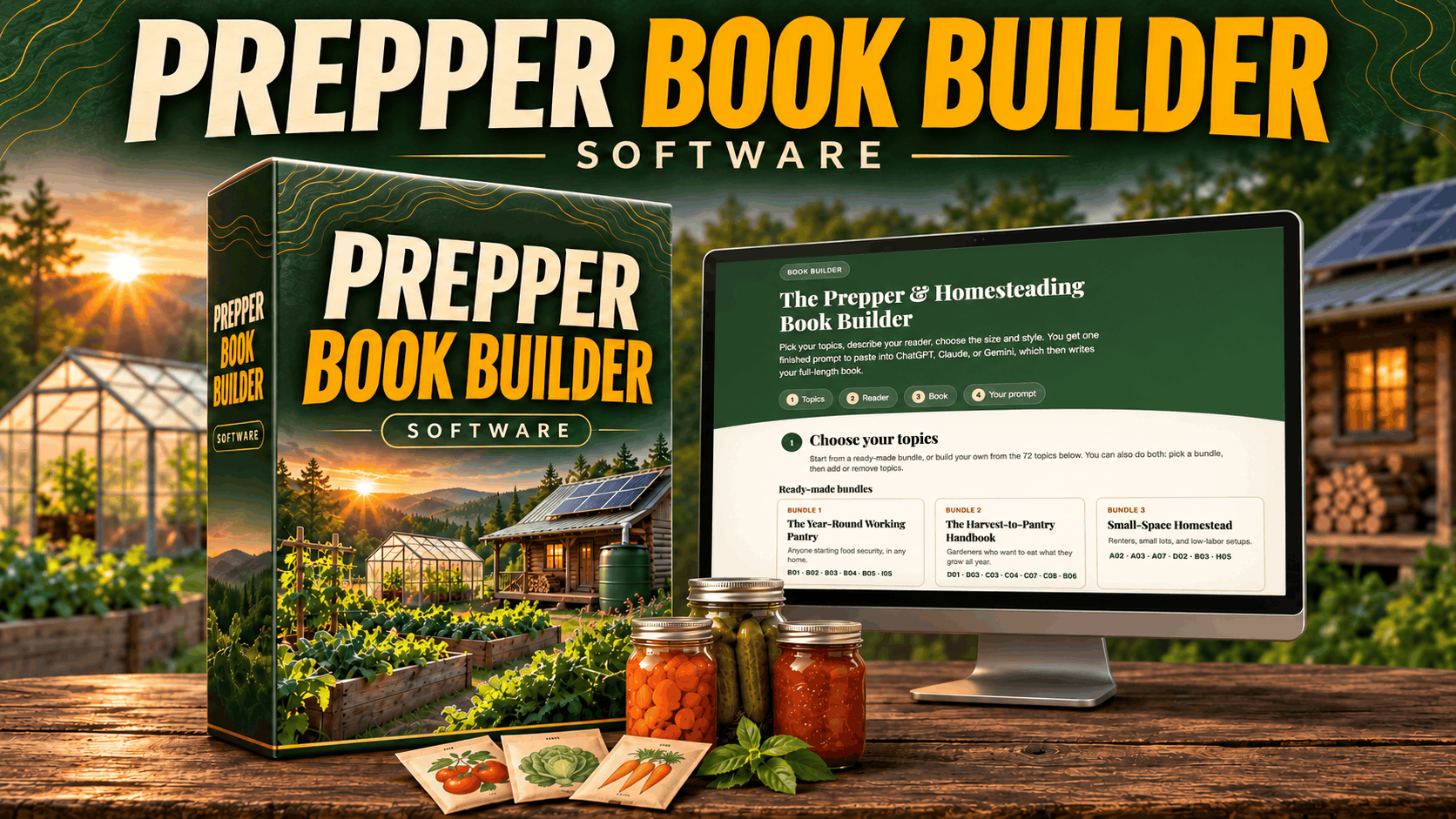
- The Prepper & Homesteading Book Builder, the browser tool
- 72 topics across nine families
- Six ready-made topic bundles
- Four book formats and three length ranges
- Reader customization: experience, household, space, region, climate, budget
- Your custom megaprompt, generated for every project, ready to paste into your AI
- The chapter-by-chapter workflow with built-in commands and progress tracking
- The Publishers Launch Kit Builder — your complete launch kit, included
Instant access: the builder is hosted on my website, so there's nothing to download or install.
You can sell every book you create with it. The royalties are yours.
Super bonus · included free
The Publishers Launch Kit Builder
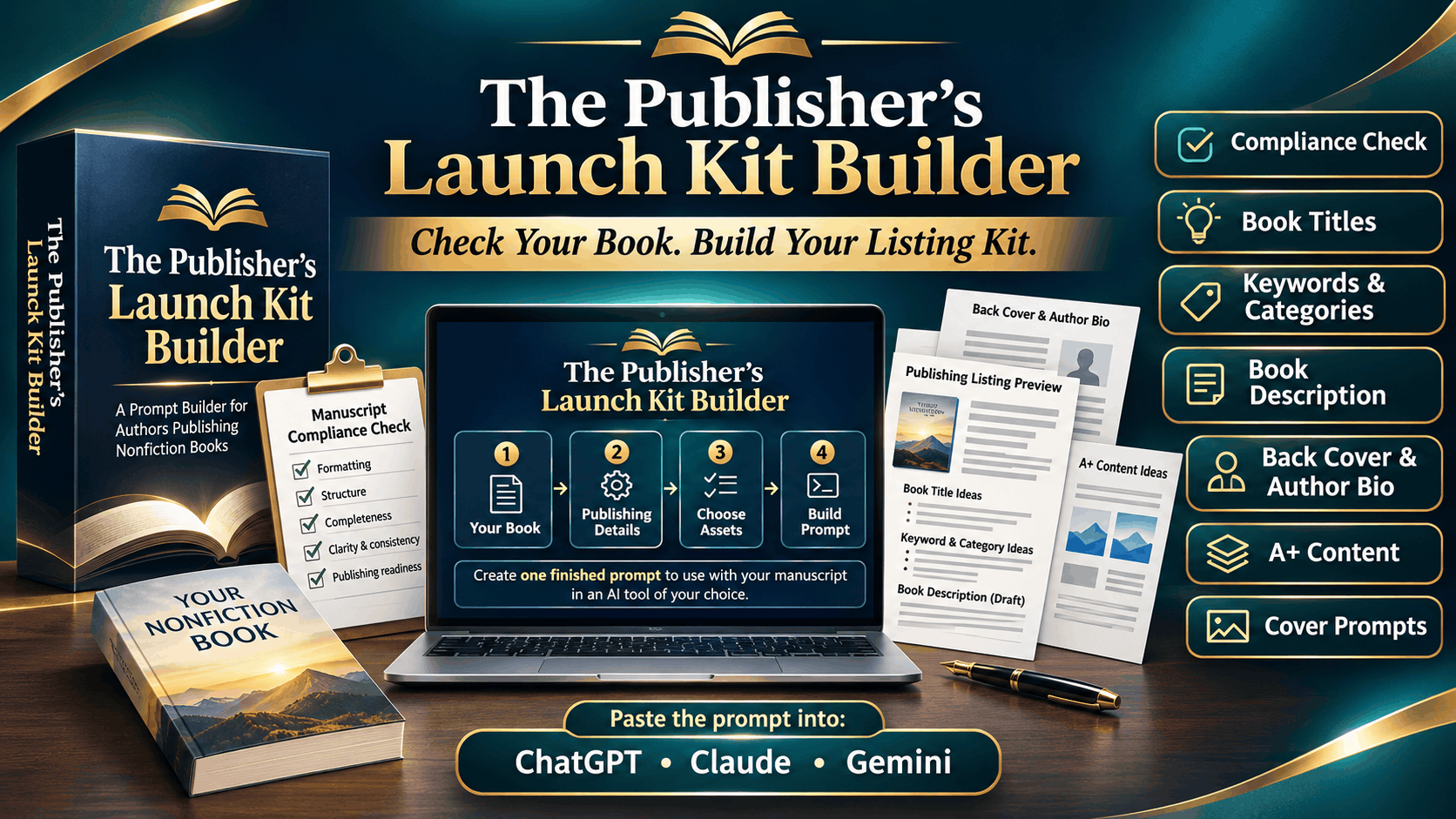
A finished manuscript isn't a launch. Before your book can sell, the listing has to be written and checked: title, keywords, categories, description, back cover, author bio, A+ content, cover concepts. This builder does that second half.
It builds all of this from your book:
- A compliance check, run first — finds risky claims, missing disclaimers and leftover [VERIFY] markers, then helps you fix them before anything goes live.
- Five title and subtitle options with character counts, under the 200-character limit.
- Seven keyword phrases plus backups, and three category directions for every format you publish.
- A book description up to 4,000 characters, in plain and formatted versions, plus back cover copy.
- An author bio in short and long versions, built only from your real background.
- An A+ content plan and three cover prompts, each with an image prompt at 1,600 × 2,560.
- A store blurb for your own site, Gumroad or Etsy.
- A launch checklist for before, during and after upload.
How you use it
Answer four short steps — your book, where you're publishing, what you need — then copy the prompt into a new chat and attach your manuscript. Type DONE for the compliance report, FIX ALL to repair what it finds, then KIT and NEXT for each asset. SAVE any time to pick it up later.
It works for the series you're writing in: Prepper & Homesteading, Wilderness & Bushcraft, Urban & Tactical Survival, Medical & Herbal First Aid, or any other nonfiction.
The compliance check is an AI-assisted review aid. It can miss things and it isn't legal or medical review — you're still the one who publishes.
Dimesale
Today's Price: $17, The Final Step
This is a dimesale: the price rose $0.10 every 10 sales. It has now reached the $17 ceiling, the highest it will ever be.
So there is no cheaper price coming back. What you see today is the builder's final price.
Lock in today's price:
Your 14-day guarantee
Try It For 14 Days. Risk-Free.
Pick a topic, generate your prompts, and build your first guide.
If the builder isn't right for you, email puck82@gmail.com within 14 days of purchase and you'll get a full refund. No questions, no hoops.
Questions publishers ask
A few things you might be wondering
Will this really give me a 25,000-word guide in an hour?
That's what happened in my own test. Your time depends on the AI you use, your plan's limits, and how many changes you ask for along the way. The workflow is built so you're approving a plan and moving through chapters, not writing from scratch.
I'm new to this genre. Do I need to know anything about prepping or homesteading?
No. You choose the topic and describe the reader. The brief guides the AI through the planning and the content. Ready-made bundles give you a proven starting point if you don't know where to begin.
Which AI do I need?
Any capable AI writing assistant, such as ChatGPT, Claude or Gemini. Your AI subscription is separate from the builder. I built and tested it with Claude, which is the AI I use for all my writing.
How is this different from a free "write my book" prompt?
A free prompt lets the AI decide everything. The builder hands it a complete editorial brief: a defined reader, a planned table of contents, one practical job per chapter, worked examples, worksheets, a source ledger and an editorial checklist. Same AI, very different book.
What about longer books?
The megaprompt includes progress tracking and a source ledger. If you need to switch to a new chat, carry over the approved plan and the latest project status. Always keep your own saved copy of the manuscript.
Should I check the content before publishing?
Yes, as with any nonfiction you publish. The brief points the AI to authoritative sources and flags anything unsupported. For topics where safety matters, such as food preservation, drinking water and electrical systems, give those chapters a careful review. It protects your readers and your reviews.
Can I sell the books I create?
Yes. Publish them on KDP and keep the royalties.
What if it's not for me?
You have 14 days to try it. Email puck82@gmail.com for a full refund.
From
Alessandro Zamboni

Creating and selling digital products since 2008
I built this builder on one standard: every chapter must help the reader make a decision, fill in a useful record, or understand a practical system. That's the kind of book readers keep, and the kind of book that stays useful long after this month's hot niche is forgotten.
Trends will keep coming and going. You can keep chasing the next one, or you can start building a catalog of books readers need every year.
Pick one topic tonight. Have your guide by the end of the evening.
To your next book,
Alessandro Zamboni
P.S.
Prepping and Homesteading Guides Are Forever.
This Is Not a Trend.
A practical pantry, garden or home energy guide can be useful in every month of the year. The builder gives your AI the brief it needs to write one in about an hour. That's what happened in my own test with Claude.
P.P.S. The dimesale has reached its final $17. That price will not come back. And you're covered by the 14-day refund either way.